

 Brussels
X-VET presented at a sustainability seminar in Latvia
At an Erasmus+ sustainability event of VIAA, Latvia’s State Education Development Agency, HOTEL SCHOOL presented the X-VET approach and tools.
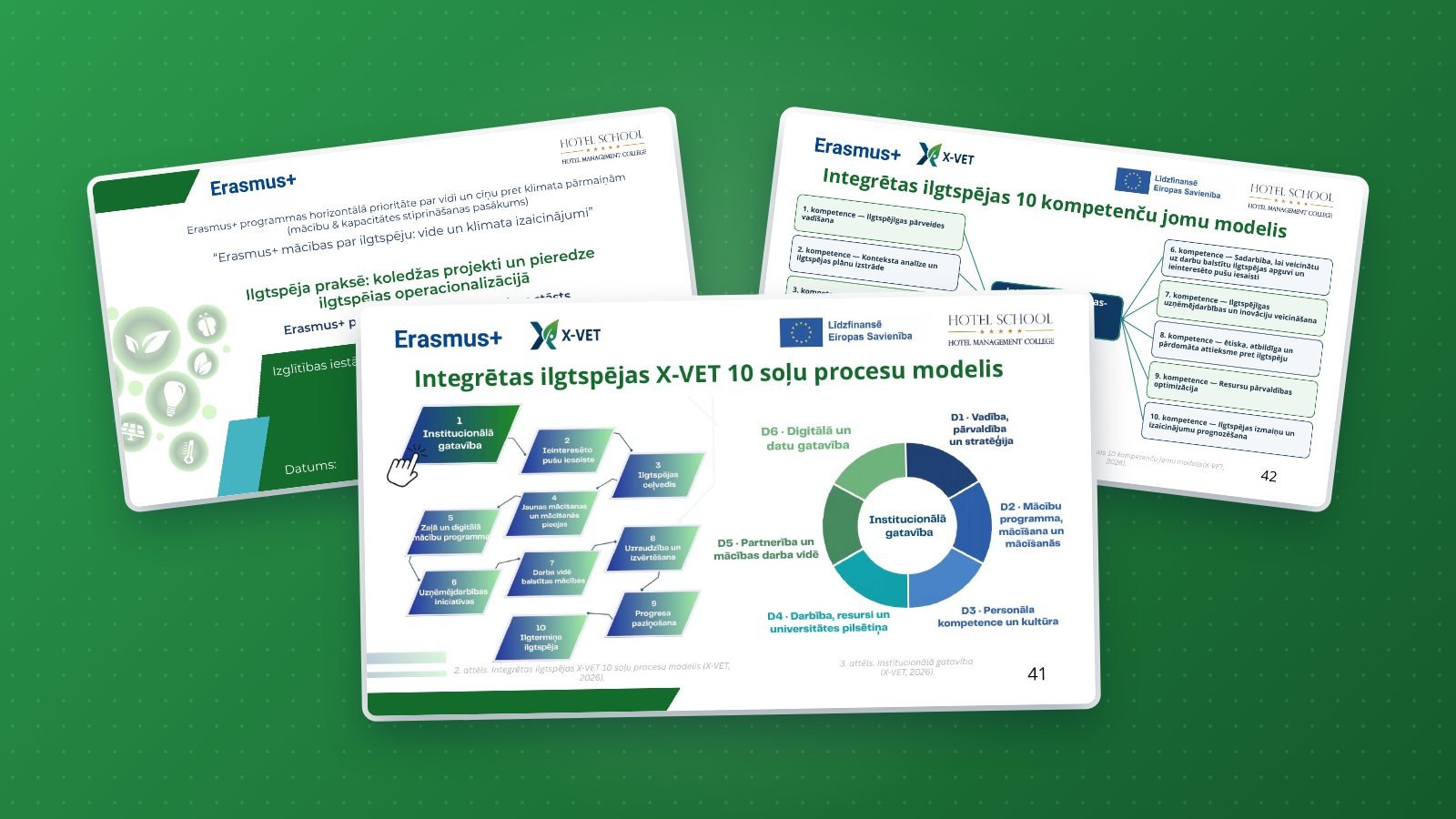
On 22 September 2026, Olga Zvereva — development director, lecturer and project manager at HOTEL SCHOOL Hotel Management College in Riga — spoke as an expert at “Erasmus+ training on sustainability: environment and climate challenges” (“Erasmus+ mācības par ilgtspēju: vide un klimata izaicinājumi”). The event was organised by VIAA, the State Education Development Agency of Latvia, as a learning and capacity-building activity under the Erasmus+ horizontal priority on the environment and the fight against climate change.
Sustainability in practice: one college’s experience
Her talk, “Sustainability in practice: the college’s projects and experience in operationalising sustainability”, was framed as the story of an Erasmus+ project implementer. She showed how HOTEL SCHOOL has built sustainability into its teaching step by step through European projects — among them the Sustainable Hospitality Digitalisation Toolkit, the Nordplus Adult project NO LEFTOVER Nordic/Baltic Culinary Arts, the virtual-reality Master Chef Simulator for sustainable gastronomy, and mixed-reality training in culinary pre-preparation techniques.
From principles to recipes
A central part of the talk was a study by Olga Zvereva and R. Artamonovs (2026), “Environmentally friendly foods: a sustainable nutrition perspective in Latvia”, linked to the International Sustainable Gastronomy and Digital Chefs Congress in Karabük, Türkiye. It tackles a gap that many VET teachers know well: turning broad sustainability principles into concrete learning outcomes and assessment criteria that students can apply in a professional kitchen — and at home.
The study tests its framework on a menu of three linked dishes designed to leave no waste: fried mackerel with potato and dill purée, a mackerel soup made with the fish bones and vegetable peels from the first dish, and curd pancakes that use up the remaining curd. Each dish was assessed for its carbon footprint, local sourcing and waste. Only the main course needed optimising — leaving out the butter and replacing the cream with milk and flour lowered its footprint by 23% — and the menu as a whole met the zero-waste goal.
X-VET: the whole institution on board
Olga Zvereva then presented X-VET and its whole-institution approach, in which sustainability is a central dimension of education rather than a separate initiative. She linked it to the European conference “Whole Institution Approach & Education for Sustainable Development: From Policy Vision to Educational Transformation”, held in May 2026 under the Cypriot Presidency of the Council of the EU, and noted that Latvian does not yet have an agreed translation for the term.
She introduced the main models of the Integrated Sustainability Workbook, finalised in July 2026:
- Six institutional domains that need to move in one direction: leadership, governance and strategy; curriculum, teaching and learning; staff capability and culture; operations, resources and campus; partnerships and work-based learning; and digital and data readiness.
- The 10-step process model, from institutional readiness and stakeholder engagement to communicating progress and long-term sustainability.
- Ten integrated sustainability competences, from leading sustainable transformation to forecasting sustainability changes and challenges.
- Ready-to-use tools for every step, such as a sustainability readiness self-assessment matrix, a stakeholder mapping framework, a sustainability roadmap canvas, a transformative learning design canvas and an annual sustainability review.
She closed with the X-VET MOOC, now being developed under HOTEL SCHOOL’s lead: a free online course of 11 modules for VET leaders and administrators, educators and trainers, and learners.
HOTEL SCHOOL’s role in X-VET
HOTEL SCHOOL, founded in 2010, is a VET provider and accredited higher education institution in Riga specialising in hospitality and tourism. It holds the Erasmus Charter for Higher Education (ECHE) and Erasmus+ accreditations for vocational education and training and adult education, and offers short-cycle professional higher education, vocational programmes and adult education courses. In X-VET it leads the work on the MOOC, and it hosted the second transnational partner meeting in Riga in July 2026.
Reaching beyond the partnership
Events like this help X-VET reach VET providers and decision-makers beyond the partnership, one of the aims of the project’s dissemination work. At the Riga meeting, the partners reviewed the dissemination recorded so far and agreed that national activities should be expanded in each partner country — an expert contribution at a national Erasmus+ event is exactly that kind of activity.
Would your organisation like to learn more about X-VET or invite the partnership to an event? Get in touch through the contact page.
Sources
#XVET#ErasmusPlus#VET#Sustainability